

 Listen Now
  Add to Playlist

As a career architect-sculptor, Larry Brown created a vocabulary of freeform shapes that bring a sense of naturally flowing, organic dimensionality to his art. Recently, he applied his methods to a municipal scale art project using recycled fiberglass boats. His goal was to make large fine art pieces and park scale sculptures.
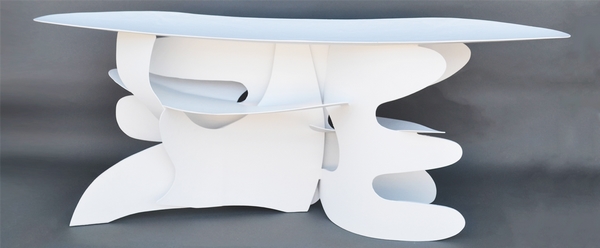
Top: “Undulating Passion,” a contemporary table built out of scrap boats and WEST SYSTEM Epoxy by Larry Brown.
The idea of using boats came to mind after a different source of materials fell through. Brown had attempted to salvage materials for the project from a local industrial plant undergoing demolition. When that didn’t work out, he found promise in the expanse of boat hulls and deck surfaces. A drive around a coastal community revealed scores of unused fiberglass boats stashed in backyards and at marinas. The possibility of using old boats as his source material captivated his imagination. The question became how to extract useful components from those existing hulls and decks.
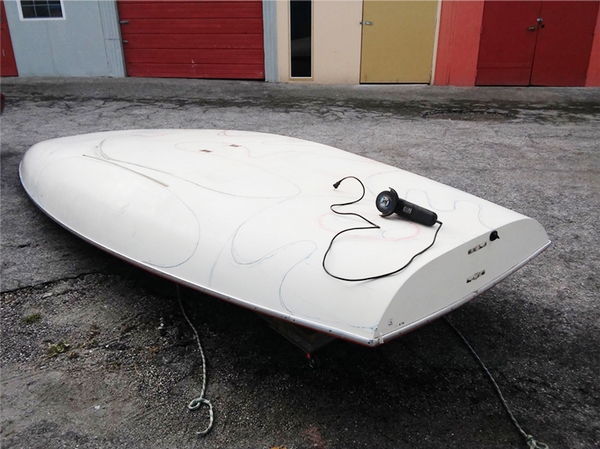
To prove the idea that boats could become art, he sketched several organic shapes over a drawing of a sailboat hull. He drew these same artistic shapes in perspective and then combined them to visualize a whole, standing sculpture.
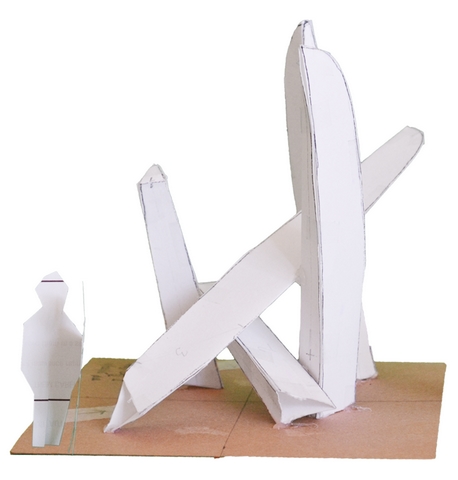
Each sketch was reproduced to ½” scale on 64# cover stock. He made sure all the parts would fit on the surface of the Rhodes 19 class centerboard sailboat that was available. Next, he assembled a paper model by cutting the cardboard and gluing the parts together with hot melt glue. This 3D model proved that freeform shapes cut from boats could, in fact, make fine art. This model helped him demonstrate his core idea to others, as well as mark the boat for the cutting stage.
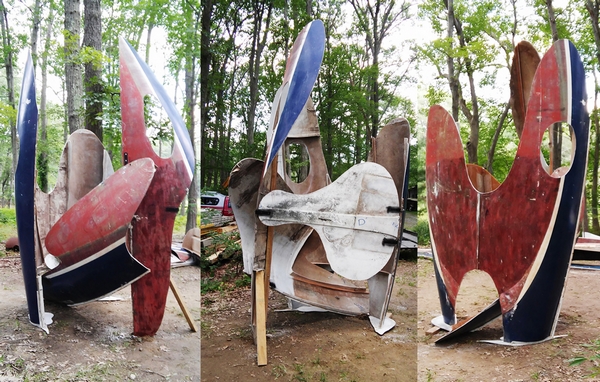
The Rhodes 19 sailboat became Brown’s first “proof of concept” sculpture. At 12′-6″ tall, the finished piece can be seen from a great distance in the landscape. The juxtaposed curved fiberglass panels and multiple holes in the design enrich its dimensionality with light and shadows. The openness invites people to walk in and around this abstract outdoor sculpture.
A second boat sculpture was a byproduct of the cuttings made from an unwanted 17′ centerboard sailboat with a cutty cabin. During the slicing of the cockpit and deck, two 9′ long fiberglass coaming pieces stood on end, immediately framing the view of the landscape beyond these tusk-shaped pieces. This discovery led Brown to fabricate a base to fix the same relationship of the tusks to one another. He welded a Z-shaped base from scrap jungle gym bars. This twin tusks sculpture now graces a historic New England garden.
While exploring the assembly of a variety of styles of marine craft, Brown combined four sailboards vertically along with one elevated surfboard at a horizontal angle, making a 12′ tall art presentation.
A national competition to submit designs to recycle old canoes as park sculptures along the Huron River in Ann Arbor, Michigan inspired him to use aluminum canoes for public art. This competition allotted a dozen canoes per sculpture. Brown arranged these in a splayed, upright, flower-like configuration. This sculpture’s 12′-wide interior provides a cathedral view to the sky and speckled views out to the surrounding river and parkland. People can walk through the 17′-tall outdoor structure year-round. This sculpture received an honorable mention award in the Ann Arbor competition.
A single-person Laser sailboat provided the material to make a dozen art panels for a 3′- long tabletop sculpture. Brown used WEST SYSTEM Epoxy to connect all the panels together.
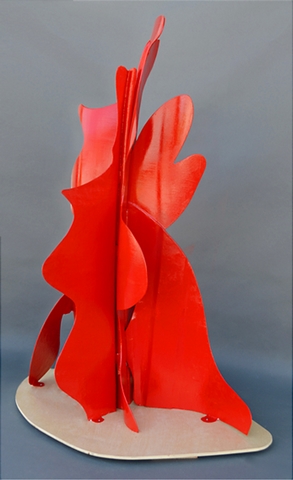
At nearly six-foot tall a red flame shape sculpture called “Flicker” is assembled from parts created out of fiberglass dinghies. Epoxy coated fiberglass mat and cloth strips connect its six curvy panels, with the same tabbing process mounting the entire art piece to its base.
“Undulating Passion” is a 7′- long fine art console table assembled from parts cut out of an MC Scow sailboat. Fiberglass tabs connect the boat panels to make a modern functional table. There are no obvious signs that this piece of contemporary art is made from recycled materials.
The hulls from a G-Cat catamaran and a Hobie 18 catamaran promise to become a spiky, 14′- tall sun tanning bench in Florida. Brown has built a scale model, and the four hulls are ready to be marked, sliced, and assembled into their new art form. Upon completion of this abstract and gossamer sculpture, Brown is seeking to find it a home where others can enjoy it.
The collection of artful furniture and abstract sculpture fabricated from fiberglass panels shaped out of boats of all sizes seen in this article confirms that high-quality art can be created from repurposed boat material. Boats as Art promises to become a unique contribution to American Art.
In order to evolve his burgeoning idea to repurpose boats as art, the artist is actively pursuing a few large-scale sculpture assignments. Perhaps your community has unloved fiberglass boats that could be turned into contemporary dimensional art and modern public sculpture. The artist, Larry Brown, enjoys transforming architectural and environmental elements into culturally advanced art.
Larry Brown
LCB Studios
Sarasota FL and Beverly MA
larrybrownstudio.com