An Introduction to Wood/Epoxy Boat Building Techniques
Spring, 2026

GET STARTED
FREE PRINT & DIGITAL EDITIONS
Spring, 2026
Contemporary wood/epoxy construction offers versatile approaches to building custom, one-off boats that combine traditional craftsmanship with modern materials. The Gougeon Brothers’ book on Boat Construction explains boat-building techniques for creating strong, lightweight, and durable boats ranging from small dinghies to large sailing yachts. These same techniques can also be used to build smaller custom parts such as hardtops, furniture, and center consoles.
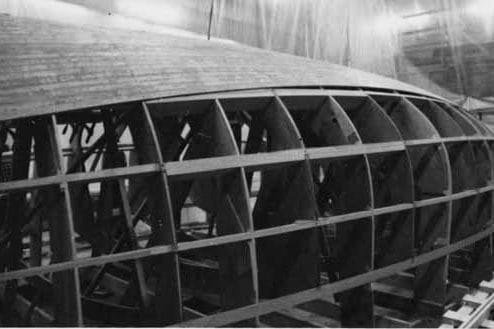
Every successful boat-building project begins with proper planning. Designs must provide accurate dimensions to build a fair hull or part. A fair surface is one with smooth, flowing lines free of bumps or irregularities. Structural details are also critical to ensure the vessel achieves the required strength and stiffness. Engineering calculations determine appropriate material thicknesses, reinforcement schedules, and construction methods to build a safe boat that will perform as intended.
One of the most significant advantages of contemporary wood and epoxy construction is the ability to control the moisture content of the wood. Maintaining constant moisture content reduces the chance of rot and improves dimensional stability. This allows stiff reinforcing fabrics, such as fiberglass and carbon fiber, to be bonded directly to the wood without the movement that would otherwise cause them to crack or delaminate. All seams can be epoxied rather than caulked, which means drier bilges and a more structurally unified hull.
Achieving this stability requires complete encapsulation. All wood components must be thoroughly sealed before assembly. Every surface, every edge, and every hole drilled for screws or hull fittings must be sealed with epoxy to create a complete moisture barrier. This protects the wood and creates a stable, dry structure.
It’s worth noting that restoring traditionally built boats with WEST SYSTEM® Epoxy uses a different approach. Instead of encapsulating, traditional built boat planks should be epoxied together and coated on the outside only. The interior remains uncoated to allow the wood to breathe. This method is appropriate for boats built with traditional techniques but does not provide the complete moisture protection of full epoxy encapsulation.
Not all wood species perform the same. Wood selection depends on balancing the tradeoffs across several characteristics, including weight, rot resistance, dimensional stability, aesthetics, and cost. Regardless of the species selected, all wood should have a moisture content between 8% and 12% for dimensional stability during and after construction.
Cedar offers lightweight properties combined with natural rot resistance at a reasonable cost, making it a popular choice for many builders.
These tropical woods cost more but provide excellent rot resistance and attractive appearance. Okoume is particularly favored for marine plywood.
While oak provides exceptional strength, it presents challenges due to its dimensional instability. It tends to change shape significantly with moisture variations. Oak requires special attention when gluing and should be used selectively.
Spruce is very light weight with good strength properties and moderate rot resistance, making it suitable for structural members where weight is a priority.
Ash also offers low weight and good strength but lacks natural rot resistance, so it must be thoroughly sealed with epoxy.
When using plywood, marine-grade plywood is essential. Marine plywood features waterproof glue, no internal voids, more plies for strength, and is typically made from okoume. All holes drilled in plywood must be sealed with epoxy to prevent moisture intrusion into the edge grain and core plies.
One of the strengths of wood and epoxy construction is the range of boat-building techniques available. Whether the project is a small kayak or a large sailing yacht, there is an approach suited to the hull type, the available materials, and the builder’s experience level.
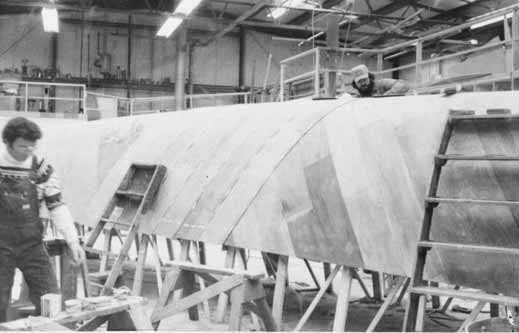
This method uses a ribband mold (a framework of temporary forms over which thin wood veneers or plywood strips are bent and laminated). Staples or small nails hold the wood in position until the epoxy cures, creating a strong monocoque shell. The ribband approach provides ample area for fastening the veneers, ensuring good contact between layers and the ability to pull them into the desired shape.
The term cold molding implies using an adhesive that does not need heat to cure. This technique is often used to build larger hulls. These typically have multiple layers of veneer applied at various angles over a mold. This cross-grain lamination provides exceptional strength and stiffness. Fitting pieces requires careful trimming to maintain fair curves without gaps (spiling).
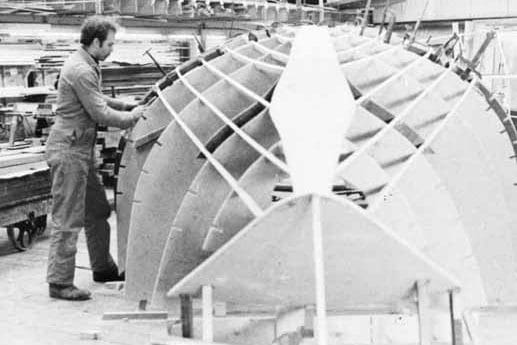
The string/frame construction technique is similar to veneer molding, except it incorporates internal stringers and frames. This method works well for boats of any size. The additional structure allows for thinner planking, reducing weight and material costs while maintaining strength.
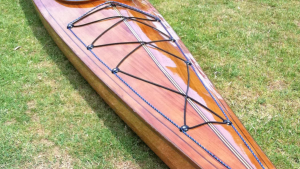
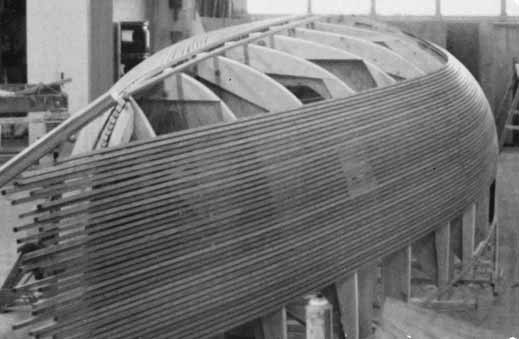
This is a very popular method for building canoes and kayaks. In strip planking, builders create frames or station molds, then apply narrow planks edge-to-edge over these forms. The planks are temporarily fastened with staples, screws, or clamps while being edge-glued with epoxy. This technique allows builders to create complex compound curves from simple lumber. The temporary fasteners can be removed after cure, or in some cases, the entire hull is built over permanent bulkheads that become part of the structure.
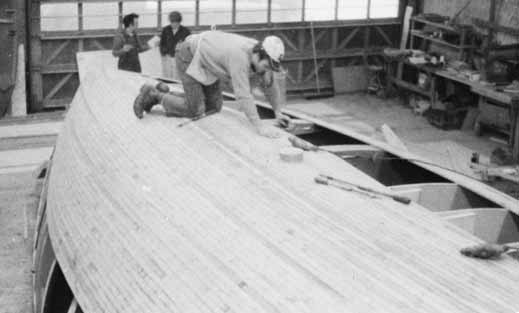
This is a very popular method for building canoes and kayaks. In strip planking, builders create frames or station molds, then apply narrow planks edge-to-edge over these forms. The planks are temporarily fastened with staples, screws, or clamps while being edge-glued with epoxy. This technique allows builders to create complex compound curves from simple lumber. The temporary fasteners can be removed after cure, or in some cases, the entire hull is built over permanent bulkheads that become part of the structure.
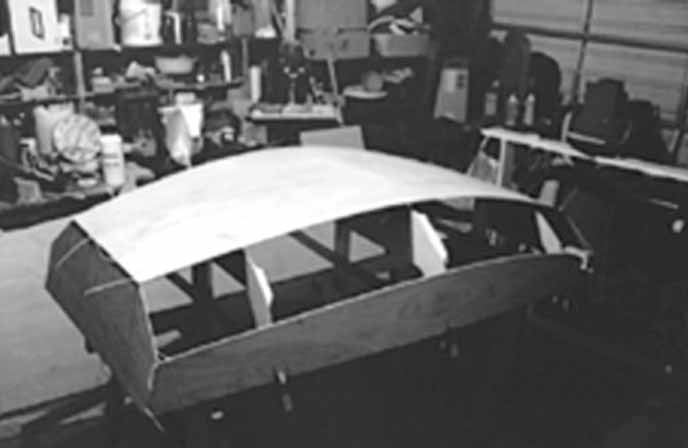
Stitch-and-glue is a popular boat-building technique for hulls of many sizes and is especially accessible to first-time builders. The plywood panels are “stitched” together with temporary wire or cable ties before being permanently joined with epoxy fillets and fiberglass tape. This method requires minimal frames or molds, and the plywood reduces cost and the number of pieces needed. The trade-off is that plywood limits hull shapes to those with distinct chines rather than smoothly rounded sections.
The fillet radius at joints is critical to strength. Therefore, fillets need to be properly shaped with an adequate radius to distribute loads effectively. Builders often use simple tools, like plastic discs, to create consistent fillet shapes.
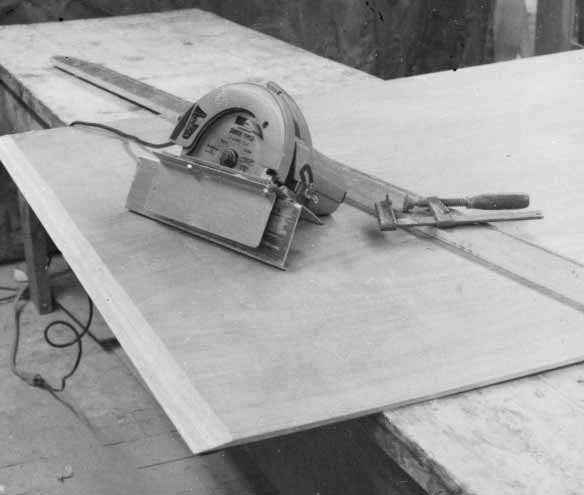
Any of these methods may require joining boards or plywood sheets end-to-end when standard lengths aren’t long enough. A scarf is a beveled edge on two joining ends of boards—often created with power planers or saws—to achieve smooth, matching bevels. Specialized scarfing jigs mounted on benches help create accurate, repeatable joints. When done properly, the overlap creates a nearly invisible joint. We recommend an 8:1 bevel to provide sufficient bonding surface for a strong bond without creating a hard spot at the joint. For ½” thick material, an 8:1 bevel would produce a 4″ long joint.
Two-step bonding is essential for scarf joints because the end grain absorbs more epoxy than the surface grain. Moderate clamping pressure is all that is needed to hold the joint while it cures. For plywood, the glue lines should run parallel to maintain strength.
Similar construction methods can be applied when building with composite materials rather than wood. Foam strips or thermoformed foam sheets can be used to form a core over a mold. Then fiberglass or carbon fiber skins are applied to the outside. Once cured, the hull is removed from the mold or frames, and the interior is laminated with a fiberglass or carbon fiber skin. This creates a sandwich structure with an exceptional stiffness-to-weight ratio.
Whether building with wood or composites, building a safe boat requires engineering analysis. These calculations determine the appropriate laminate schedule for the inner and outer skins, core thickness, and reinforcement placement. This is all done to ensure the hull achieves the required strength and stiffness while minimizing weight. Building a safe boat requires balancing these factors with proper construction techniques and quality materials.
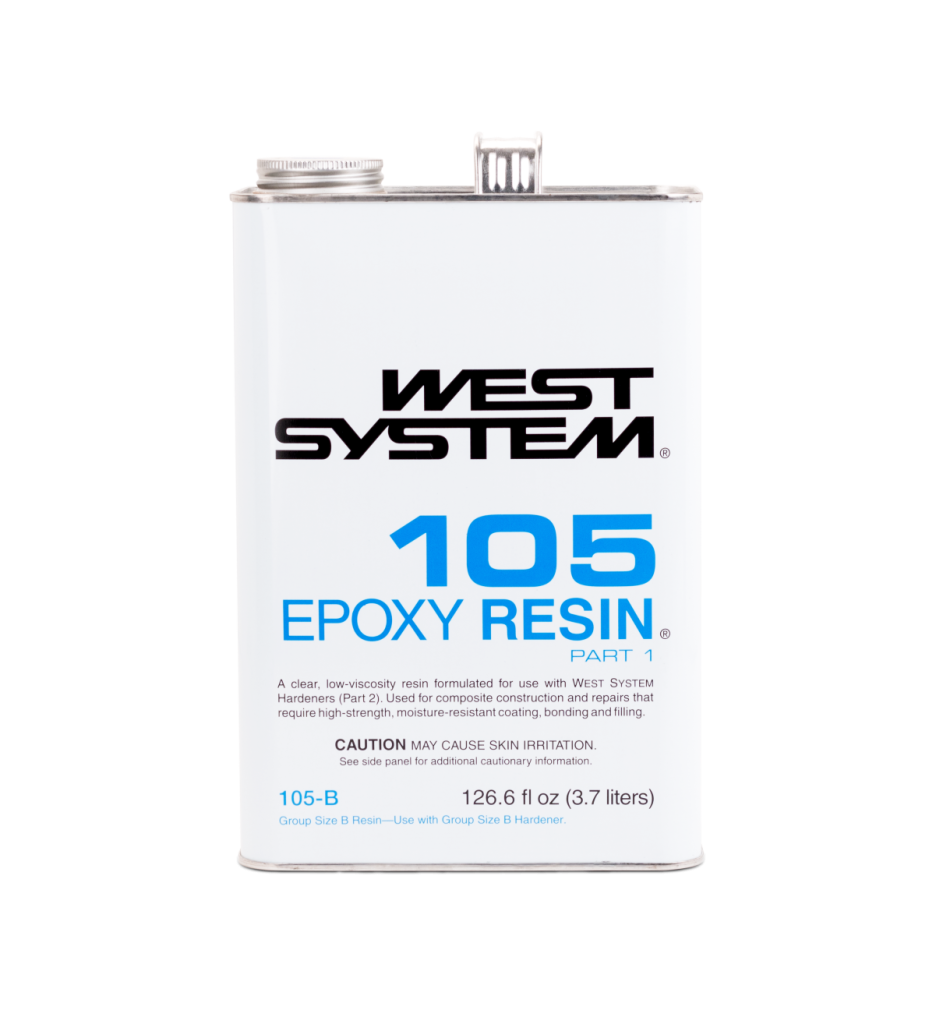
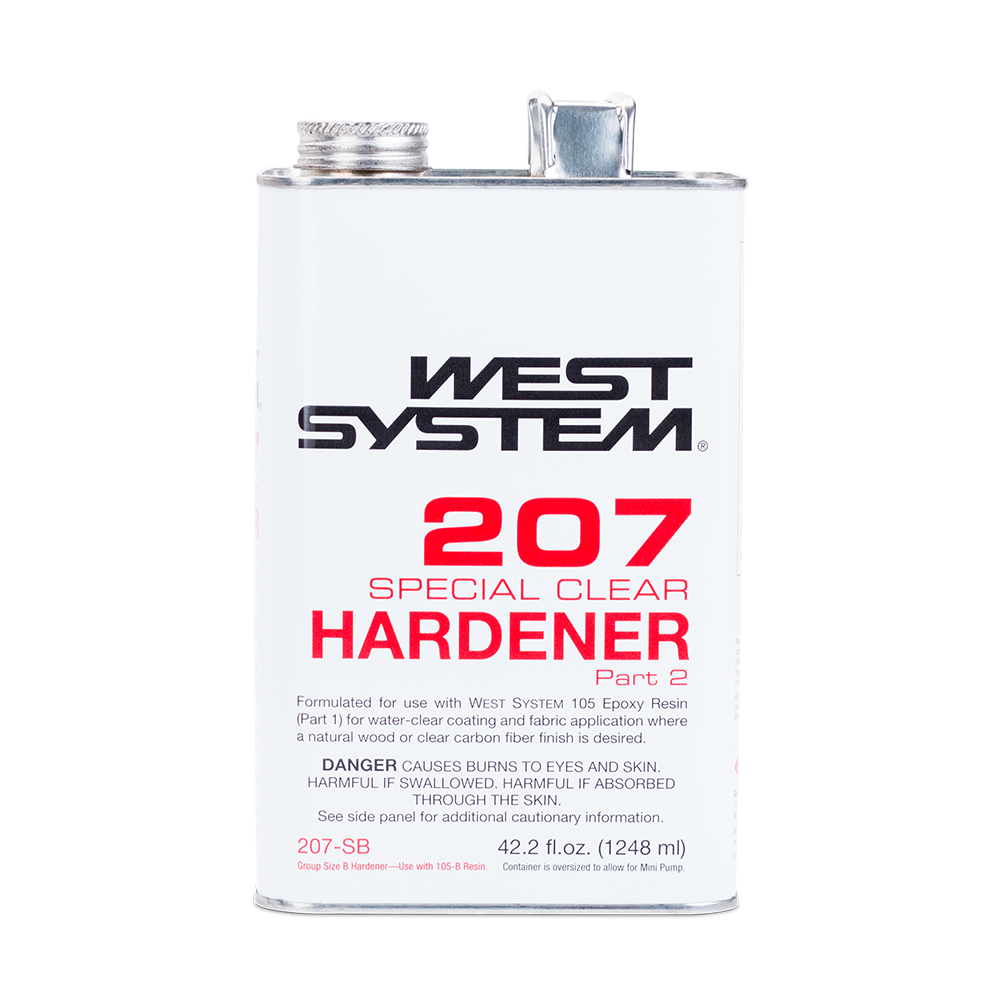
After construction, proper surface preparation is essential before applying varnish or paint. Any amine blush must be washed away, and surfaces sanded smooth before painting. For clear finishes over wood, using 105 Epoxy Resin® with 207 Special Clear Hardener® provides optimal clarity and UV resistance. A high-quality marine varnish or urethane coating will provide the needed UV protection for a durable, long-term bright finish.
Boat building with WEST SYSTEM Epoxy offers tremendous flexibility in construction methods, materials, and vessel types. Whether working with traditional woods like cedar and oak, modern marine plywood, or advanced composites with foam cores, the fundamental principles remain consistent: careful planning, proper moisture sealing, appropriate material selection, and sound construction techniques all contribute to creating attractive, durable boats that provide years of reliable service on the water.
Read more articles like this one! Check out our “BOAT CONSTRUCTION” category.


 Listen Now
  Add to Playlist