Wood Rot Repair Epoxy vs. 105 System
November 14,
2026

GET STARTED
FREE PRINT & DIGITAL EDITIONS
November 14,
2026
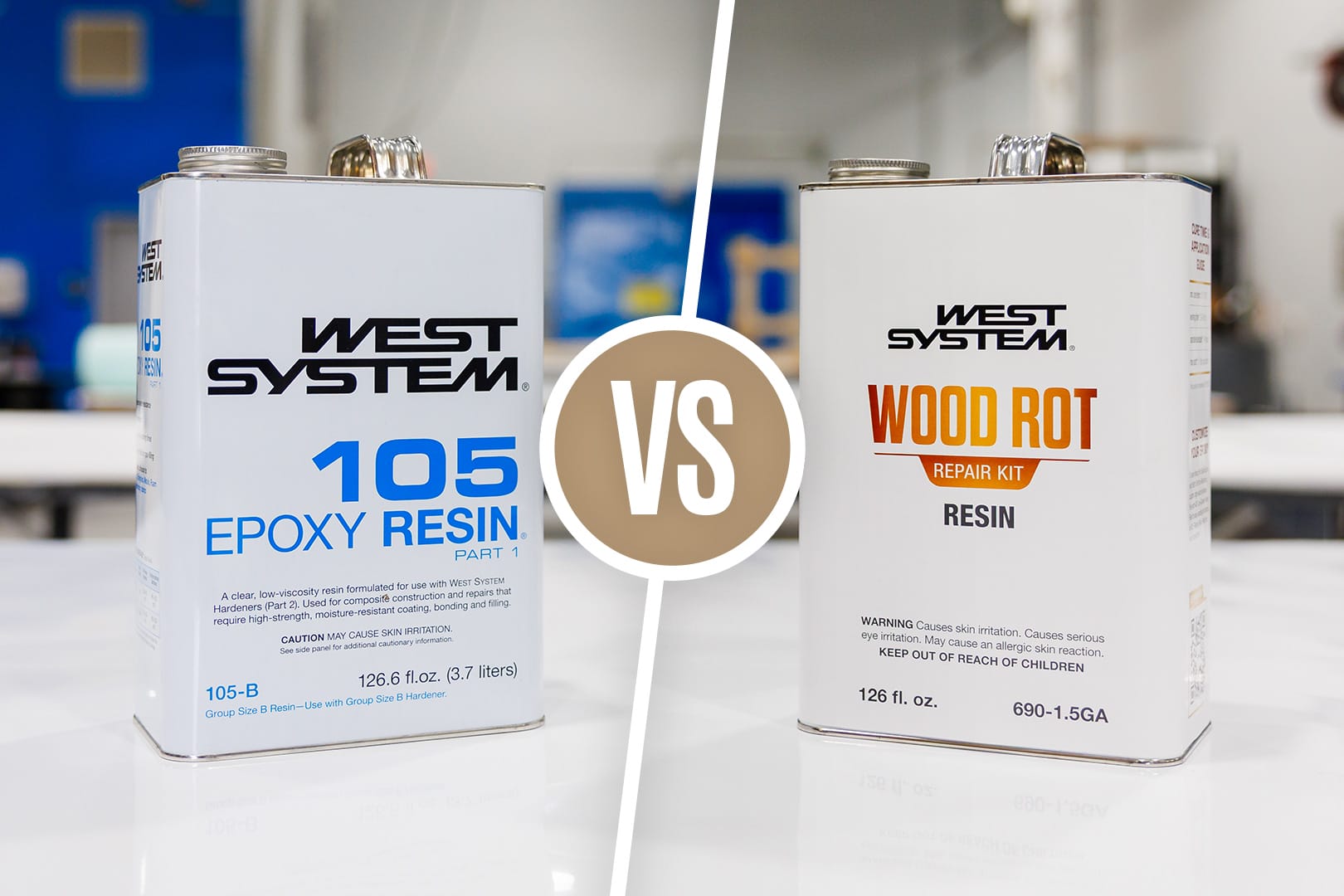
Our Wood Rot Repair Epoxy is the newest epoxy from WEST SYSTEM®. It is a highly specialized product, unlike the 105 System, and therefore it has some very specific use cases. This article will cover the differences between the two in terms of mechanical properties, why we made these design choices, and when we recommend using Wood Rot Repair Epoxy (…and when we don’t).
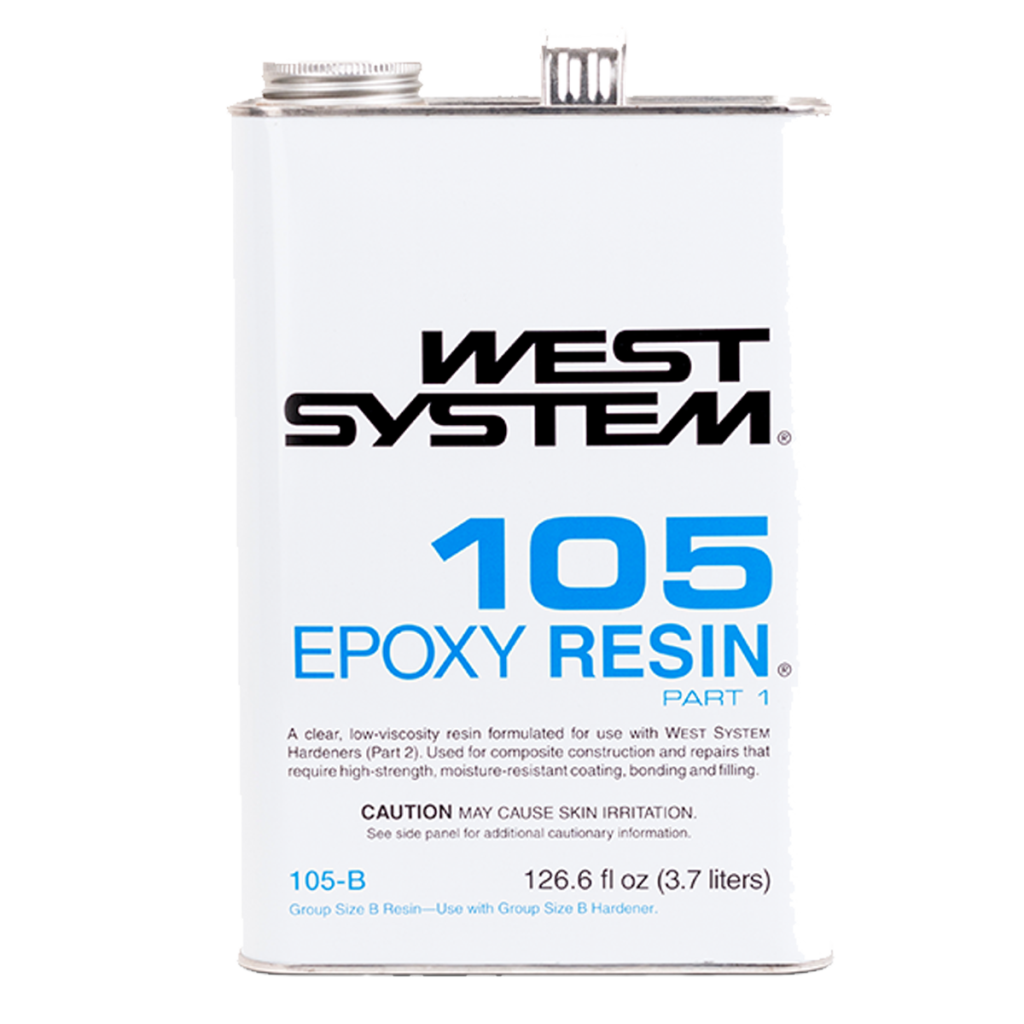
Every WEST SYSTEM product is engineered with mechanical properties matched to its original purpose. The 105 System was developed primarily to bond and protect boats from moisture, a role that has since grown to cover a much wider range of applications due to the versatility of the system.
Wood Rot Repair Epoxy takes a different, more focused approach. Rather than serving multiple purposes, it’s built to do one thing well: penetrate areas of localized, softened wood and reconsolidate them, restoring strength where rot has taken hold.
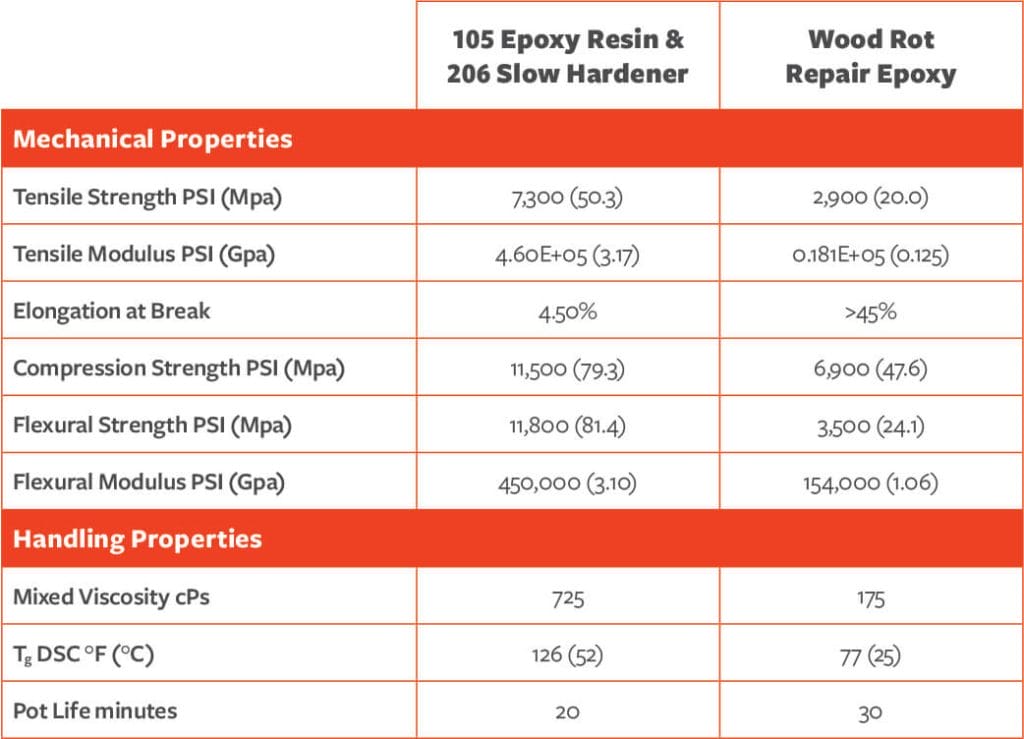
The table compares the properties of the two systems. Wood Rot Repair Epoxy has a much lower viscosity, much higher elongation, higher flexibility, and a longer pot life. All these traits help it to be successful at consolidating damaged wood. Conversely, 105 Epoxy Resin®/206 Slow Hardener® exhibits much higher strength, stiffness, and a higher Tg, all of which are traits desirable for a hull crashing into waves or for rigging under load.
To penetrate rotted wood, a low viscosity is needed to fully encapsulate the compromised wood fibers. This is especially important when doing isolated repairs on otherwise solid wood. When we tested this in the shop, we simulated rotted wood by compacting sawdust in a clear cup. We added the same amount of compacted sawdust to two cups and poured nearly 100 grams of either Wood Rot Repair Epoxy or 105/ 206 into each. The epoxy was allowed to soak in for 20 minutes. A black line was drawn on the cups to indicate the wet line at that point. After that, more epoxy was added to the top as a second coat. That second coat was allowed to soak in for 40 minutes.
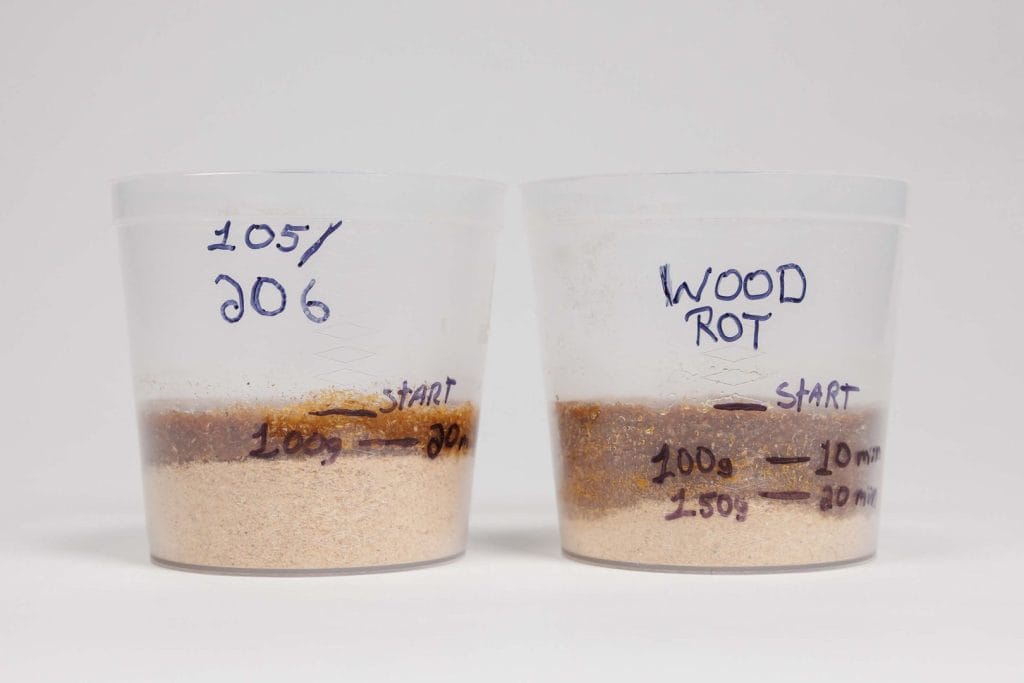
After a total combined penetration time of 60 minutes, we took a picture of both epoxy systems. The mixing cup with Wood Rot Repair Epoxy penetrated almost twice the distance as the 105/ 206 within the initial 60 minutes.
The penetrating ability is primarily due to Wood Rot Repair Epoxy’s low viscosity, but it is also aided by its slower cure speed. As someone who has left a layer of 105/ 206 in a mixing cup, it doesn’t take a very thick layer before it cures to a solid. Because Wood Rot Repair Epoxy needed to be used for much deeper penetration, the epoxy needed to cure slower than the 105/ 206 to allow more time for it to work its way into the compromised wood. That deeper penetration also means more epoxy volume ends up in the wood than a typical surface application would leave behind, and the slower cure helps keep that larger volume from generating too much heat as it cures. We did this while achieving a minimum cure temperature of 50°F (10°C), even lower than the 105/ 206 at 60°F (16°C).
Another notable property is the extremely high elongation reduced stiffness of this product. It is important to remember that Wood Rot Repair Epoxy is designed for isolated repairs where the whole surface is not being coated. This application is also why the elongation is much higher than the 105 System. When moisture enters wood, either due to a change in humidity or other means, the wood expands; when moisture leaves, it contracts. Because this product is used for spot repairs, moisture can still enter and exit the wood, causing it to shrink and expand over time. With a very stiff product, debonding or cracking in the epoxy may occur. The flexibility of Wood Rot Repair Epoxy allows it to move with the wood.
Wood Rot Repair Epoxy is great at what it is designed for: penetrating deep into compromised wood and remaining flexible to accommodate its movement, even when the wood remains unsealed. This specialized performance is what sets Wood Rot Repair Epoxy apart from the 105 System.
When it comes to sealing with a barrier coat, the 105 System truly shines on its own. Testing during development showed that on sound, uncompromised wood, the 105 System matches or exceeds the penetration depth of competitors penetrating systems, while also delivering superior moisture protection. The 105 system glows especially bright when we look at the Tg of each of these products (or the temperature at when they begin to soften). The Wood Rot Repair Epoxy has a much lower Tg and will be much softer at warm temperatures than the 105 System.
The elongation of this product rivals that of our current most flexible product, G/flex®, but Wood Rot Repair’s lower strength makes it unsuitable for any bonding that will be subject to high loads.
Wood Rot Repair Epoxy is compatible with the WEST SYSTEM line of fillers and works especially well with the 407 Low-Density Filler. This mixture is great for sanding and shaping shallow areas where wood was missing or removed. While it works with all fillers, it does not make much sense to use structural adhesive fillers in this product, as the epoxy is not designed for structural applications.
It’s worth noting that Wood Rot Repair Epoxy is an expertly engineered material for penetrating and consolidating rather than a structural filler, and that distinction is strength. While it cures hard like all epoxies, its value lies in restoration and stabilization. For structural members or larger areas of rot, the 105 System, paired with a properly scarfed new piece of wood, is the ideal solution. This ensures full load transfer and long-term integrity. We have also found that while the 105 System is compatible with styrene-based foams, the Wood Rot Repair Epoxy is not, and can dissolve some foams.
Finally, neither the 105 System nor Wood Rot Repair Epoxy is a good option for a couple of things. Neither of these products kills the fungi that cause wood rot, but both will inhibit continued growth by cutting off two of the things it needs to spread: moisture and oxygen.
While Wood Rot Repair Epoxy can be used to coat isolated areas, neither of these products should be used to coat structures that have not been edge-bonded together. Because the joints are not sealed, cracks can appear, and moisture can infiltrate. This can cause the underlying wood to rot.
Wood Rot Repair Epoxy is a highly engineered product designed for one particular task: reconsolidating rotted or compromised wood. It is especially valuable to use if the wood is decorative, intricate, or difficult to replace. What it is not is the 105 System. We do not recommend it for bonding, gluing in a dutchman, or coating new wood. Wood Rot Repair Epoxy is not a fix-all solution for every piece of rotted wood. What it is, is a quick fix for isolated areas of rot to help stabilize a problem that can continue to grow if not treated correctly, and it will be most effective when used along with other rot-killing/prevention techniques.


 Listen Now
 Add to Playlist